
Between lagoons, wild beaches and Christian legends, 29 km from our 3-star campsite in the Camargue, Saintes-Maries-de-la-Mer sums up everything that makes the Camargue so charming, in the Bouches-du-Rhône. Here is how to plan a meaningful visit, whatever the time of year, from our campsite near Saintes-Maries-de-la-Mer.
Key facts
- A town in the Rhône delta, in the Bouches-du-Rhône, in the heart of the Camargue Regional Nature Park, about 27 minutes from Camping Crin Blanc.
- Founded on the Christian legend of Mary Jacobe, Mary Salome and their servant Sara, who became the patron saint of the Roma people.
- A 9th-century fortified church, a Camargue bullring, a local museum and 38 kilometres of wild, fine sandy beaches.
- Two major events: the Roma pilgrimage (24 and 25 May) and the Provençal pilgrimage (third weekend of October).
- The village inspired the film Crin Blanc (White Mane) in 1953 and welcomed Vincent van Gogh in 1888.
A town between land and sea, in the heart of the Camargue
Saintes-Maries-de-la-Mer stretches between lagoons and the Mediterranean, in the Rhône delta, on the edge of the Bouches-du-Rhône and Provence. The town boasts 38 kilometres of wild beaches, bordered by the Camargue national reserve and its landscapes of rice fields, bulls and white horses. People come as much for the sea as for the hinterland: marshes, salt meadows and flamingos create a wild setting unlike any other town on the French coast, or even in Europe. Nearby, Arles and Aigues-Mortes complete a Camargue triangle that many visitors from all over France combine in a single stay.
Centuries of history, between legend and faith
The village’s name comes from a legend that is still very much alive: according to Christian tradition, Mary Jacobe, Mary Salome and their servant Sara landed here after fleeing Palestine, nearly twenty centuries ago. Sara has since become the patron saint of the Roma and travelling people, while the two holy Marys gave the town its name. The church, built from the 9th century and fortified over the years to protect its relics from pirate raids, remains the beating heart of this story; it still holds the relics venerated during the pilgrimage. This religious fortress withstood invasions for centuries, as its thick walls and wall walk remind us. A little further into Provence, another saint left his mark on the region: Louis IX, the future Saint Louis, set sail from Aigues-Mortes for the Crusades, proof that this land has always attracted stories of faith over the years.
Heritage to see in the village
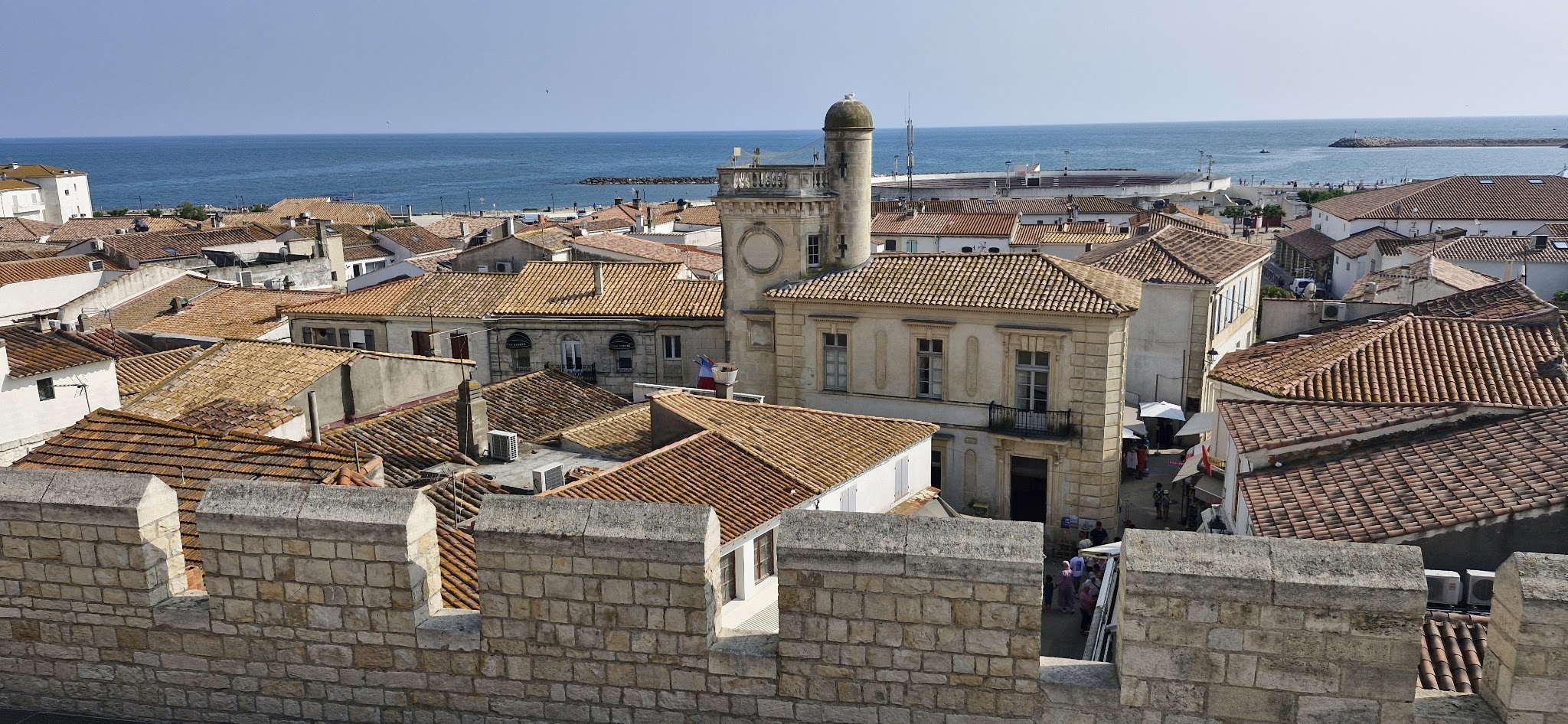
The fortified church comes first, with its crypt dedicated to Saint Sara and access to the roof terrace, which offers a view over the town’s whitewashed rooftops.
The bullring hosts courses camarguaises for much of the year: a typical course lasts about two hours. A traditional course usually features six bulls, each spending 15 minutes in the ring, with an interval of about 15 minutes after the third bull. Add to that the presentation of the raseteurs at the start (the capelado) and any entertainment at the end.
The local museum traces the maritime and gardian history of the town, with a tribute to the Marquis Folco de Baroncelli (1869-1943), bull breeder, gardian and fervent defender of Camargue traditions. Founder of the Nacioun Gardiano in 1909, he helped preserve and promote the culture, costumes and traditions of the gardians.
Film and painting lovers will find a double nod here: the village was the setting for the film Crin Blanc (White Mane) by Albert Lamorisse, released in 1953, which gave the campsite its name, and Vincent van Gogh painted several seascapes here during his stay in June 1888. He later returned to these landscapes in his canvases painted in Arles.


Wild beaches as far as the eye can see
Unlike many seaside resorts in the region, Saintes-Maries-de-la-Mer has kept its wild nature, with no heavy development. The central beach, close to the village, suits families; the beaches further east, towards the mouth of the Rhône, take more effort to reach and reward you with peace and quiet. The resort is open all year round, but the best time to enjoy the beach without the crowds is outside July and August. In high season, the resort changes and fills up quickly, especially around the bullring and the seafront.
A land of living Camargue traditions
Camargue culture is everywhere: in the reed-roofed gardian cabins scattered across the surrounding land, in the courses camarguaises held in the bullring, in the herds of bulls and horses that have made this land famous for generations. Horse riding remains one of the best ways to discover the Camargue, between lagoons and marshes, as does a visit to the Pont de Gau ornithological park, next to the Regional Nature Park. The abrivados, Camargue traditions in which mounted gardians lead herds of bulls through the streets, also punctuate the local calendar and attract many visitors every year. This culture even reaches your plate: gardiane de taureau, a bull stew simmered for hours, remains the signature dish of the whole region, and can be enjoyed in the village as well as at the Camping Crin Blanc restaurant.
The Roma pilgrimage and the calendar of major events
Every year on 24 and 25 May, the statues of Saint Sara and then of the holy Marys are carried in procession to the sea, escorted by gardians on horseback. A second highlight, the Provençal pilgrimage, takes place on the third weekend of October. The local calendar also includes the Fèsto Vierginenco at the end of July, in honour of the Virgin, and an abrivado festival in November: two more chances to see the region’s traditions come alive through the seasons and the years.
Planning your stay from Camping Crin Blanc
The village is easy to reach from Arles or from Camping Crin Blanc, about a 27-minute drive. The tourist office, right in the centre of town, provides information on visiting hours and the full calendar of events.
To make the most of the Camargue, there is nothing like staying close to its must-see sites. About thirty minutes from Saintes-Maries-de-la-Mer, Camping Crin Blanc is an excellent base for heading to the beach first thing in the morning, before the heat, then coming back for lunch at the campsite restaurant. In the afternoon, it’s up to you: explore the Alpilles or Arles, discover other landscapes of the region or simply relax by the pool with a good book. An ideal way to combine outings with the good life, without spending your holiday on the road!


