
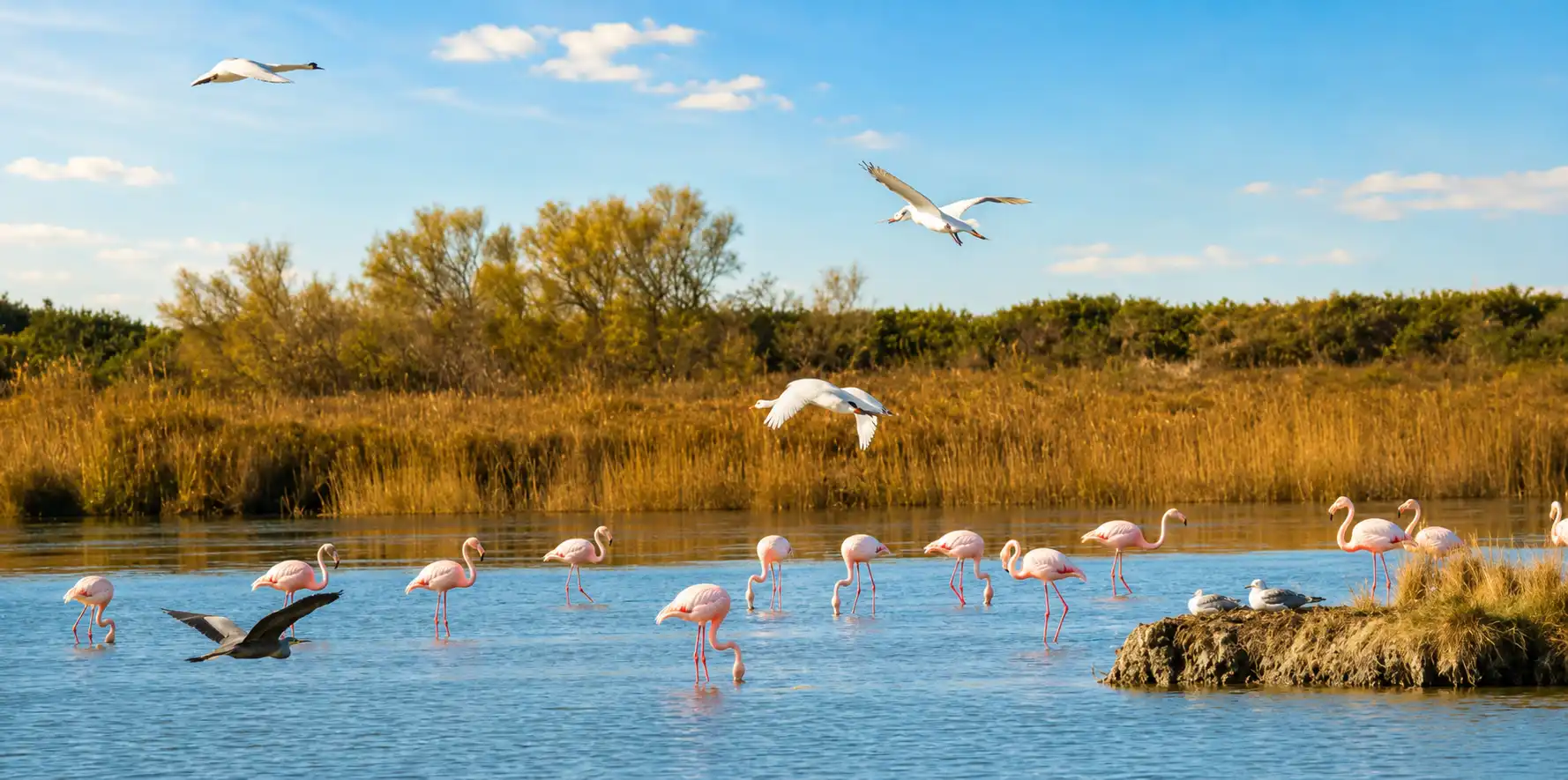
Flamingos, herons, egrets, stilts… The Camargue is one of the finest places in Europe for birdwatching. From our Camping Crin Blanc, in the heart of the Camargue Regional Nature Park, several protected natural sites open their trails and hides to you. Here is our selection for spotting the birds of the Camargue during your stay.
Our view
For a first family outing, we start with the Pont de Gau ornithological park: the flamingos let you get very close. The most patient will continue to the hides at La Capelière, preferably early in the morning, when the birds are most active.
The Camping Le Crin Blanc team
Key points
- Six protected sites between 17 and 54 km from the campsite, with trails and hides.
- The Pont de Gau ornithological park is the best place to see flamingos up close.
- Go out early in the morning or late in the day, with binoculars and mosquito repellent.
The best birdwatching sites around the campsite
The Musée de la Camargue and the Mas du Pont de Rousty trail
Housed in a former sheepfold at the Mas du Pont de Rousty, in the municipality of Arles, the Musée de la Camargue tells the story of the delta’s life and landscapes. It is also the starting point of a discovery trail with hides, free to access, which runs alongside a reed bed and seasonal marshes. You can see herons, reed-bed songbirds, waders in spring and ducks in winter. An easy visit to combine with discovering the history of the Camargue.
La Capelière, home of the Camargue National Reserve
On the shore of the Étang de Vaccarès, 27 km from the campsite, La Capelière is the visitor centre of the Camargue National Nature Reserve, one of the largest protected wetlands in Europe (13,000 hectares, 276 bird species recorded). A trail of about 1.5 km, dotted with four hides, lets you discreetly approach the Eurasian bittern, the great egret or the kingfisher. An interactive exhibition area presents the reserve and its treasures. Nearby, the Salin de Badon trail, also part of the reserve, offers great sightings of spoonbills and greylag geese.
The Pont de Gau ornithological park
4 km north of Saintes-Maries-de-la-Mer (24 km from the campsite), the Pont de Gau ornithological park is the ideal place to see flamingos up close. Across 60 hectares of marshes, lagoons and reed beds, 7 km of trails with hides also let you admire herons, avocets, black-winged stilts or terns depending on the season. The park has a care centre that takes in hundreds of injured birds every year. A favourite outing for families.
The Scamandre reserve, in the Camargue gardoise
Near Gallician, 17 km from the campsite, the Scamandre Regional Nature Reserve protects 146 hectares of marshes, lagoons and reed beds in the heart of the Camargue gardoise. Its waymarked trails invite you on a peaceful walk among the reeds, to meet herons and wetland birds. A quieter site, ideal for a calm morning in nature.
The Marais du Vigueirat
At Mas-Thibert (39 km from the campsite), where the Rhône delta meets the Crau plain, the Marais du Vigueirat National Nature Reserve covers about 1,200 hectares. More than 300 bird species have been recorded there: glossy ibis, Eurasian bittern and flamingo all year round, European bee-eater, purple heron and black-winged stilt in summer. Around fifteen kilometres of trails can be explored on foot or by horse-drawn carriage, with guided walks to go further.
The Domaine de la Palissade
Near the mouth of the Grand Rhône, at Salin-de-Giraud (about a 45-minute drive, or 53.5 km from the campsite), the Domaine de la Palissade covers 702 hectares outside the dykes: it is the last witness to the delta as it evolved before the major works of the 19th century. Owned by the Conservatoire du littoral and managed by the Camargue Regional Nature Park, it offers three waymarked routes, for self-guided or guided visits. Flamingos, Kentish plovers, black kites in summer and ospreys on migration are regularly seen there. Horse rides and kayak trips on the Rhône are also offered by local partners.
Which birds can you see in each season?
- All year round : flamingo, great egret, grey heron, Eurasian bittern, common shelduck.
- In spring and summer : European bee-eater, purple heron, black-winged stilt, pied avocet, terns.
- On migration : waders, osprey.
- In winter : ducks, teals, greylag geese.
Our tips for a successful outing
- Choose early morning or late afternoon, when birds are most active and the light is softest.
- Bring binoculars, water and mosquito repellent from April to October.
- Stay on the trails and respect the peace of the sites: dogs are not allowed at most of them.
- Prices and opening hours : they vary by site and season, and can be found on each natural site’s website.
- To go further : download the booklet “Where to watch birds in the Camargue and the Alpilles?”, published by the Camargue and Alpilles Regional Nature Parks.
After a day watching for flamingos and herons, come back to the peace and friendliness of our campsite in the Camargue, surrounded by rice fields and marshes: the ideal starting point for exploring the Camargue at the pace of its birds.
Frequently asked questions
Where can you see flamingos near the campsite?
At the Pont de Gau ornithological park, 24 km from the campsite and 4 km north of Saintes-Maries-de-la-Mer: it is the best place to see them up close. You can also see them all year round at the Marais du Vigueirat and the Domaine de la Palissade.
When is the best time to watch birds?
Early morning and late afternoon, when birds are most active and the light is softest.
What is the best season for birdwatching in the Camargue?
All year round: flamingos and great egrets are always present, spring and summer bring bee-eaters and purple herons, winter ducks and greylag geese.
Are dogs allowed at the birdwatching sites?
No, dogs are not allowed at most sites, to keep the birds undisturbed.
Which site should I choose for a quiet walk?
The Scamandre reserve, 17 km from the campsite: a quieter site, ideal for a nature morning among the reeds.
Want to watch the birds of the Camargue?
Book your stay in the heart of the Regional Nature Park, a few kilometres from the finest birdwatching sites.
Previous articleDiscovering the Maison du Riz in the Camargue
