Holidays
at the Pont du Gard
From our campsite near the Pont du Gard, you can visit the Pont du Gard, which has towered over the Gardon gorges for nearly two thousand years. This guide brings together the history of the monument, the activities on site and practical information to plan your day, especially if you are staying at our campsite in the Camargue.
Key facts
- The Pont du Gard is a Roman aqueduct built in the 1st century, standing 48.77 metres above the Gardon.
- It has been a UNESCO World Heritage site since 1985 and a listed historic monument since 1840.
- The site welcomes around 1.4 million visitors a year, making it one of the most visited ancient monuments in France.
- Canoeing, swimming and hiking are all possible in and along the Gardon, right at the foot of the bridge.
- Allow just under an hour’s drive from Arles or the Camargue to reach the site.
The Pont du Gard in brief
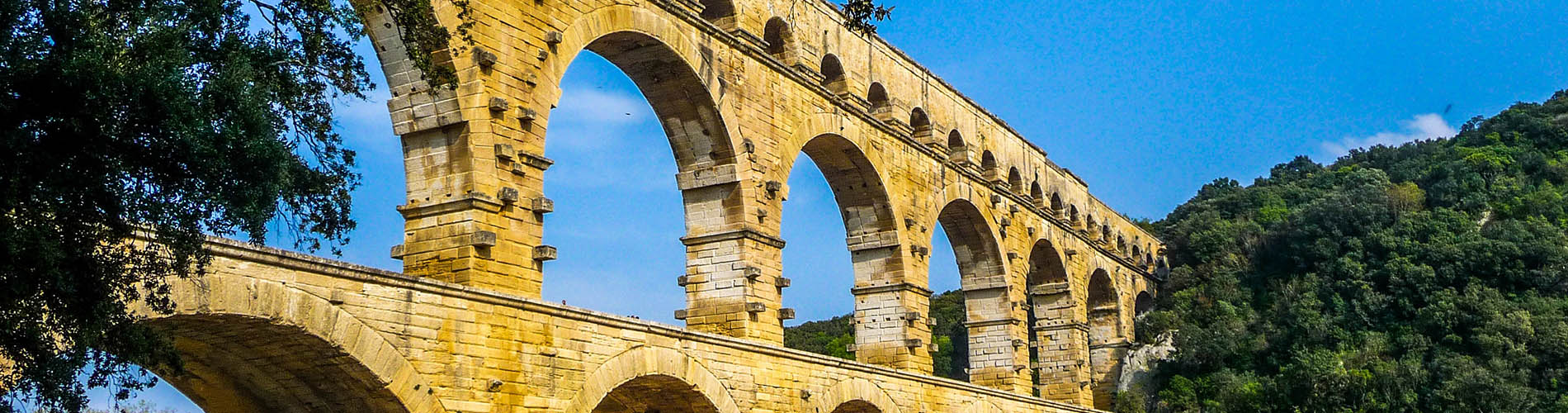
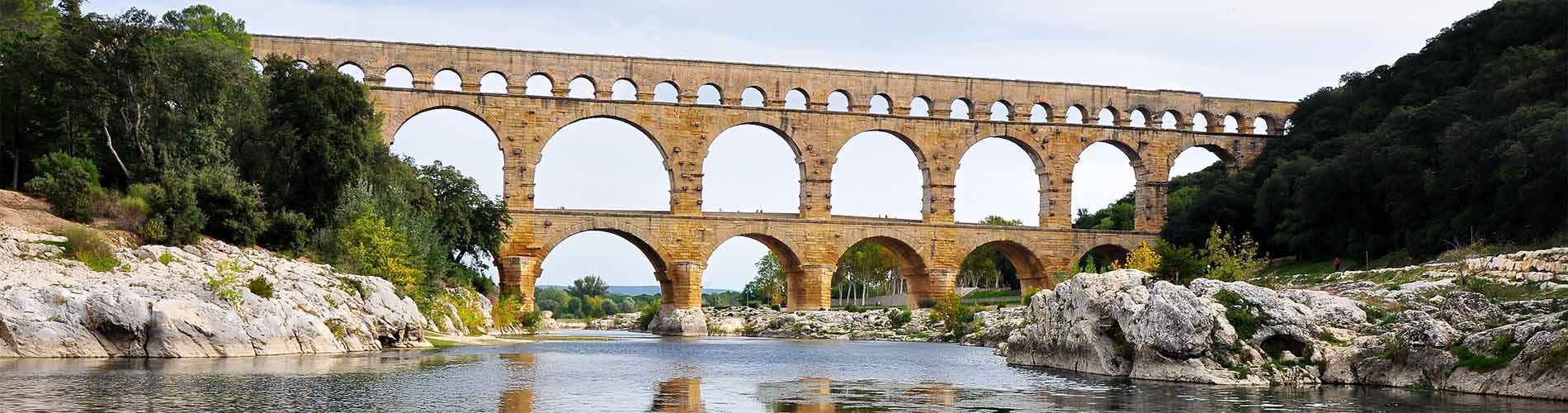
The Pont du Gard is a Roman aqueduct bridge with three tiers of arches, built in the 1st century to carry water from a spring near Uzès to the Roman city of Nîmes, over more than 50 kilometres. This water supplied the city’s baths, fountains and homes. Today, it is one of the best-preserved ancient structures inherited from Rome: a feat of engineering set in the middle of the garrigue and unspoilt nature, between Uzès and Remoulins, in the Gard department, in the Occitanie region. The site spreads over both banks of the Gardon, between the municipalities of Vers-Pont-du-Gard and Saint-Bonnet-du-Gard.
A masterpiece of Roman engineering
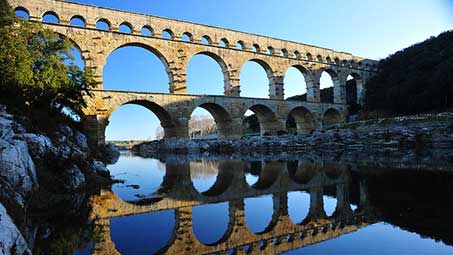
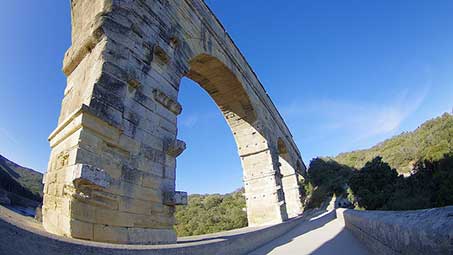
The bridge was built between 40 and 50 AD, when Rome ruled all of Gaul, in just five years, by a team estimated at around a thousand workers. Its structure rests on three tiers of arches: 6 arches on the lower level, 11 on the middle level and 35 on the upper row, which carries the aqueduct channel. Few ancient bridges reach such a height: the structure rises 48.77 metres above the Gardon, with a current length of 275 metres, compared with 360 metres originally.
This feat of construction used eleven million stone blocks, cut from the local rock and assembled without mortar for most of the structure. The Roman engineers calculated an extremely gentle gradient along the whole route, barely a few centimetres per kilometre, a precision that still commands respect. The aqueduct stopped working at the beginning of the 6th century, a victim of limescale building up in the channels and a lack of maintenance after the fall of the Roman Empire.
A UNESCO World Heritage site
The Pont du Gard has been on the UNESCO World Heritage list since December 1985, as an outstanding example of Roman hydraulic engineering. It had already been protected as a historic monument since 1840, one of the very first heritage protections in France, and is now listed as a Grand Site de France. This double recognition explains the scale of the restoration work carried out on the site since the 1990s, with the creation of a museum area and the rehabilitation of 165 hectares of garrigue around the monument.
What to see and do on site
The visit is not just about admiring the bridge from the riverbanks. The site includes a museum tracing two thousand years of history of the aqueduct and its water, a cinema and a fun trail designed for children aged 5 to 12. Several waymarked trails cross the restored garrigue and run along the Gardon, with viewpoints over the different tiers of arches.
In summer, the site hosts night-time shows with the monument lit up, a particularly memorable moment for families on holiday in the region. A restaurant and a shop complete the offer, along with a picnic area for visitors who prefer to bring their own food.
Good to know: the site and its car park are open all year round, every day from 8am to midnight. The cultural areas (museum, cinema, play area) follow seasonal opening hours: closed from November to the end of February, then gradually open from 9am to 6pm in spring and autumn, and from 9am to 8pm in July and August, closed every Monday morning for maintenance. Access to the site is charged, around €9 per vehicle; entry to the cultural areas varies with the package chosen, with free access to the discovery areas for under-18s. Please check opening hours and prices directly with the site before your visit.
Canoeing and swimming in the Gardon gorges
The Gardon gorges are one of the finest water playgrounds in the Gard. Canoeing under the arches of the bridge is a very popular family activity, with routes of different lengths depending on your level and the time available, usually offered by rental companies based upstream or downstream of the site.
You can also swim directly in the Gardon, from several pebble beaches around the bridge. The water stays cool even in midsummer, making it a welcome break after visiting the museum. More experienced hikers can also reach the Gardon gorges on foot, on a route stretching several kilometres through the nature reserve, between limestone cliffs and the white stones typical of the Gard.
From Camping Crin Blanc: how to plan your day
From the campsite, across from the hamlet of Saliers, allow about a 50-minute drive to reach the Pont du Gard, heading up towards Arles and then towards Remoulins. Check our practical information to plan your journey.
A full day lets you combine a visit to the monument in the morning, before the heat and the crowds, with a swim or a canoe trip on the Gardon in the afternoon. This is the plan most families recommend when making the round trip from accommodation in the Camargue: leave early, enjoy the museum in the shade in the late morning, then head for the water when the sun is strongest. Fancy something different the next day? Our article on horse riding in the Camargue will give you more ideas for outings.
The Pont du Gard rounds off a stay built around the great sites of the Camargue and the Arles area: rice fields, horses, bulls, and now a two-thousand-year-old Roman construction site. A must-see in the Gard, less than an hour’s drive from our mobile homes, and just as suited to a cultural morning as to an afternoon paddling in the water.
Practical information for planning your visit
- Address : La Bégude, 400 route du Pont du Gard, 30210 Vers-Pont-du-Gard.
- Getting there : allow about a 50-minute drive (60 km) from Camping Crin Blanc (across from the hamlet of Saliers), heading up towards Arles and then towards Remoulins.
- Prices : site access about €9 per vehicle; entry to the cultural areas varies with the package; free access to the discovery areas for under-18s.
- Opening hours : site and car park open all year round from 8am to midnight; cultural areas depending on the season, closed from November to the end of February.
- Booking : online booking recommended in high season, to guarantee a parking space and avoid queuing at the ticket office.
FAQ: the questions we are often asked
How much time should I allow to visit the Pont du Gard?
Half a day is enough for the monument and the museum, a full day if you add a swim or a canoe trip on the Gardon.
Can you swim at the Pont du Gard?
Yes, you can swim directly in the Gardon, from several pebble beaches around the bridge.
How much does it cost to visit the Pont du Gard?
Access to the site (car park, trails, viewpoints) is charged, around €9 per vehicle; entry to the cultural areas varies with the package chosen.
How far is the Pont du Gard from Camping Crin Blanc?
60 km, about a 50-minute drive, heading up towards Arles and then towards Remoulins.