
Holidays
in Saint-Rémy
About 43 minutes from our campsite in the Camargue, Saint-Rémy-de-Provence opens the door to the Alpilles. From our campsite near Saint-Rémy-de-Provence, here is how to plan a meaningful visit, between ancient remains, the memory of Van Gogh and the Provençal market.
Key facts
- Saint-Rémy-de-Provence is in the Bouches-du-Rhône, in the heart of the Alpilles Regional Nature Park, about 20 km from Avignon and 25 minutes from Arles.
- The village has around 9,500 inhabitants (2022) and is known as the little capital of the Alpilles.
- The archaeological site of Glanum, one of the richest in Provence, lies at the foot of the Alpilles, on Avenue Vincent-Van-Gogh.
- Vincent van Gogh spent a year at the Saint-Paul-de-Mausole monastery, where he painted more than 150 works.
- The big Provençal market takes place on Wednesday mornings, an unmissable event for anyone visiting the village.
Where is Saint-Rémy-de-Provence, between the Alpilles and the Baux valley
Saint-Rémy-de-Provence nestles at the foot of the northern slope of the Alpilles, in the Bouches-du-Rhône department. The town is often described as the little capital of the Alpilles, halfway between Avignon, about twenty kilometres away, and Arles, about a 25-minute drive. It is part of the Alpilles Regional Nature Park, a limestone massif of olive groves, orchards and charming hamlets. With nearly 9,500 inhabitants, Saint-Rémy keeps the scale of a real Provençal village despite its tourist and cultural appeal far beyond the Bouches-du-Rhône.
Part of the Provence-Alpes-Côte d’Azur region, the town has the postcode 13210. Its municipal population is around 9,500 according to the 2022 census, a figure that has remained stable in recent years. Like many Provençal villages popular with retirees, the population is rather older, with one in three inhabitants over 60; this also explains how quiet the village is outside the tourist season. The population can double in summer with the influx of visitors. This community keeps the village lively, as you can see on the market square and in the local shops. The neighbouring villages of Maussane-les-Alpilles and Les Baux-de-Provence complete this rural area rich in heritage, which a simple map of the Alpilles will help you find before setting off.
Must-see sights in Saint-Rémy-de-Provence
The archaeological site of Glanum
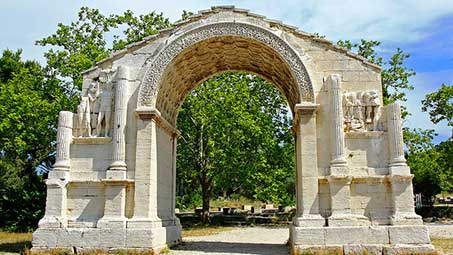
The archaeological site of Glanum tops the list of the village’s major tourist sites. This former Gallo-Roman city, which began as a Celto-Ligurian and then Greek settlement before becoming Roman, disappeared around 270 after barbarian invasions. Today you can see a forum, baths, houses with colonnaded courtyards and the famous Mausoleum of the Julii, remarkably well preserved.
The Saint-Paul-de-Mausole monastery
A stone’s throw from Glanum, the Saint-Paul-de-Mausole monastery is just as worth a visit. Vincent van Gogh voluntarily admitted himself there in May 1889 after his crisis in Arles, and spent a year painting some of his most famous canvases there, including The Starry Night. You can visit the Romanesque cloister, the chapel and a reconstruction of the painter’s room.
The Hôtel de Sade and the Musée des Alpilles
In the historic centre, theHôtel de Sade houses the centre for ancient archaeology and displays the finds from the Glanum excavations, sculptures and everyday Gallo-Roman objects. The Musée des Alpilles, in the former Hôtel Mistral de Mondragon, completes the visit with collections devoted to local history and the Provençal way of life.
The collegiate church of Saint-Martin
The collegiate church of Saint-Martin, rebuilt in the 19th century on a 14th-century Gothic bell tower, overlooks the village’s main square and houses a renowned organ. Several other monuments dot the old centre: stone houses, carved porches and Renaissance façades can be discovered on foot, between boulevards shaded by plane trees laid out on the old ramparts, fountains and pedestrian streets. Some of these buildings retain the charm of a real Provençal mansion, with an inner courtyard and a façade in Baux stone.
Our tip : enjoy a quiet stroll in the historic centre at the end of the day, when the golden light falls on the stone façades and the streets empty of day visitors. It is the best time to feel the unspoilt charm of the place and the peaceful life that fills it out of season.
Fontvieille and Les Baux-de-Provence
Beyond the centre, the neighbouring villages round off the visit: Fontvieille andits Daudet windmill, Eygalières and its flower-lined streets, or the Carrières de Lumières in Les Baux-de-Provence, an immersive digital art museum set up in former stone quarries. In the village itself,the Musée Estrine, an interpretation centre devoted to Van Gogh and contemporary painting, is a useful complement to Glanum and the Musée des Alpilles for those who want to discover more of the local culture.



Cultural activities and local events in Saint-Rémy-de-Provence
Saint-Rémy-de-Provence lives all year round to the rhythm of its traditional festivals. The village fêtes in spring combine processions, Camargue games and street entertainment. The summer feria brings together courses camarguaises and open-air concerts, while the transhumance festival at the end of May sees flocks of sheep come down from the Alpilles through the village, a moment much enjoyed by the locals.
The historic centre is home to most of this cultural life: contemporary art galleries in the old town, artists’ studios open to the public and temporary exhibitions that continue the artistic legacy of the great names who lived here. The town has always had a strong cultural identity, a place that welcomed painters and writers long before becoming one of the most popular tourist sites in the Alpilles.
How to get to Saint-Rémy-de-Provence and where to stay
By car, Saint-Rémy-de-Provence is easy to reach via the D99 from Tarascon or the D5 from Avignon. Allow about 20 minutes from Avignon, 25 minutes from Arles and just under an hour from Marseille. The nearest TGV station is Avignon, linked to the village by regular buses.
Parking in the town centre is limited on sunny days: it is better to park in one of the car parks on the outskirts and walk to the monuments in the historic centre, using the map from the tourist office.
For GPS navigation, simply enter Saint-Rémy-de-Provence or its postcode, 13210, to be guided straight to the village centre. The region’s Mediterranean climate, with hot, dry summers, also explains why so many farmhouses and hotels in the area have a pool so guests can make the most of the season.
Good to know : at the tourist office in the town centre, a free map helps you spot the main monuments at a glance: the Hôtel de Sade, the Musée des Alpilles and the market square. A dedicated stand also has a map of the hiking trails in the nearby Alpilles. Guides also mention the town house where the Nostredame family grew up, just nearby. For any post or delivery, the town’s postcode, 13210, is the simplest reference.
For accommodation, Saint-Rémy-de-Provence mainly offers boutique hotels, Provençal farmhouses and many guest houses, in keeping with the town’s preserved village spirit, one of the most sought-after addresses in France for a green getaway. In summer, many of these farmhouses have their own pool to relax after a day of sightseeing. The town’s hotels and guest houses also often have an outdoor pool, a real plus for extending a day of sightseeing in high season. For a stay in the heart of nature a few minutes’ drive away, our campsite in the Camargue offers an alternative with mobile homes, pitches and a pool, in the peace of the Camargue lagoons.
For food, the Wednesday morning Provençal market remains the unmissable place to taste local produce: olives and AOC olive oil from the Baux valley, goat’s cheese, Provençal fabrics and bric-a-brac sit side by side on the squares and boulevards of the centre. A second, smaller market takes place on Saturdays. The terraces and restaurants of the town centre complete the offer, with Provençal cooking largely based on produce from the Alpilles.
History and cultural identity of Saint-Rémy-de-Provence
The history of Saint-Rémy-de-Provence begins well before the Christian era, with the Celto-Ligurian and then Greek remains of Glanum, which became a prosperous Roman city before declining in the 3rd century. In the Middle Ages, the area belonged to the abbey of Saint-Remi in Reims, which gave the village its name. The town flourished again in the 14th century, under the nearby papacy of Avignon, then one of the most influential cities in France and Europe.
Saint-Rémy-de-Provence claims two figures who shaped its cultural identity far beyond Provence. Michel de Nostredame, known as Nostradamus, was born here on 14 December 1503: his birthplace can still be seen in the historic centre. Contrary to popular belief, he is not buried in Saint-Rémy: he rests in the church of Saint-Laurent in Salon-de-Provence, his adopted town. Vincent van Gogh, for his part, stayed here for a year from May 1889 at the Saint-Paul-de-Mausole monastery, a period of intense creativity despite his illness. The composer Charles Gounod also wrote part of his opera Mireille here during a stay in 1862.
This heritage lives on in the local economy today: the town produces an olive oil protected by the Vallée des Baux-de-Provence AOC, obtained in 1998, one of the very first olive oil appellations in France. This art of living still shapes the Provençal life of the town, between farmhouses and the landscapes of Provence-Alpes-Côte d’Azur. Between ancient remains, the memory of the great names who lived here and the landscapes of the Alpilles, Saint-Rémy-de-Provence remains a stop that gives real meaning to a stay in Provence, to be extended with a stay at our campsite in the Camargue.
Practical information for planning your visit
- Getting there : via the D99 from Tarascon or the D5 from Avignon (about 20 minutes from Avignon, 25 from Arles).
- Postcode : 13210.
- Parking : car parks on the outskirts of the town centre; the historic centre is best explored on foot.
- Accommodation : boutique hotels, Provençal farmhouses and guest houses in and around the village.
- Market : Wednesday morning (main market) and Saturday (smaller market).
- Tourist office : free map of the monuments and map of the Alpilles hiking trails.
FAQ: the questions we are often asked
What is there to do and see in Saint-Rémy-de-Provence?
Between a visit to the archaeological site of Glanum, the Saint-Paul-de-Mausole monastery where Van Gogh stayed, a stroll through the historic centre and the Wednesday Provençal market, the little capital of the Alpilles can be explored on foot in half a day or more.
What are the main tourist sites in Saint-Rémy-de-Provence?
The archaeological site of Glanum, the Saint-Paul-de-Mausole monastery, the Hôtel de Sade, the Musée des Alpilles and the collegiate church of Saint-Martin are among the must-sees in and around the historic centre.
How do I get to Saint-Rémy-de-Provence and where can I stay?
The village is reached via the D99 from Tarascon or the D5 from Avignon. Boutique hotels, Provençal farmhouses and guest houses make up most of the accommodation on offer.
What are the main events and cultural highlights in Saint-Rémy-de-Provence?
Spring village fêtes, the summer feria and the transhumance festival at the end of May punctuate the year, alongside a cultural life focused on contemporary art in the old town.
What is the history and cultural identity of Saint-Rémy-de-Provence?
Founded on the ancient site of Glanum, the town owes its name to the abbey of Saint-Remi in Reims and claims the legacy of Nostradamus, born here in 1503, and Van Gogh, who stayed here in 1889-1890.


